
🚀 Interstellar Comet 3I/ATLAS: NASA and the Unbound Visitor from Deep Space
The detection of Interstellar Comet 3I/ATLAS has ignited the astronomy world, providing a unique, fleeting opportunity to study material that originated outside our own Solar System. Designated the third known interstellar object after 1I/ʻOumuamua and 2I/Borisov, this active comet is a genuine cosmic traveler, carrying clues about chemistry and planetary formation around a distant star. NASA, along with global observatories, has mounted an unprecedented campaign to track and analyze this rare visitor as it passes through our stellar neighborhood.
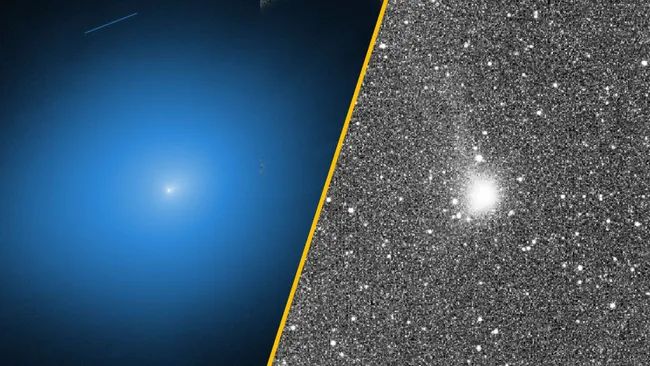
🔑 Key Facts About Interstellar Comet 3I/ATLAS
| Fact | Detail |
|---|---|
| Full Designation | 3I/ATLAS (The '3I' stands for Third Interstellar object) |
| Discovery Date | July 1, 2025 |
| Discoverer | ATLAS (Asteroid Terrestrial-impact Last Alert System, NASA-funded) telescope in Chile |
| Interstellar Proof | Hyperbolic Trajectory (Eccentricity $e \approx 6.139$), unbound by the Sun's gravity |
| Closest Approach to Sun (Perihelion) | October 29, 2025 (Distance $\approx 1.36 \text{ AU}$, just inside Mars's orbit) |
| Maximum Speed | Approximately $68 \text{ km/s}$ ($153,000 \text{ miles per hour}$) relative to the Sun |
| Nucleus Size Estimate | Between 440 meters and 5.6 kilometers in diameter (based on Hubble observations) |
| Closest Approach to Earth | December 19, 2025 (Distance $\approx 1.8 \text{ AU}$ or $270 \text{ million km}$) |
The Interstellar Origin: Why the Trajectory Matters
What definitively marks 3I/ATLAS as an interstellar object is its hyperbolic trajectory and extreme velocity.
Unbound by Gravity
Unlike comets born in our Solar System (like those from the Oort Cloud or Kuiper Belt) which follow elliptical orbits and are gravitationally bound to the Sun, 3I/ATLAS is moving too fast.
- Its orbital eccentricity is $\approx 6.139$ (where an unbound object has $e > 1$), which is the highest recorded for any known interstellar visitor.
- It entered the Solar System traveling at an incredible speed of $\approx 57 \text{ km/s}$ relative to the Sun. This **hyperbolic excess velocity** ($v_{\infty}$) means the object will simply pass by and forever exit the Solar System, never to return.
- This extreme speed and trajectory confirm it was ejected from another star system, having drifted through interstellar space for millions or billions of years before our Sun's gravity briefly captured and accelerated it.
Discovery by ATLAS
The comet was discovered on July 1, 2025, by the Asteroid Terrestrial-impact Last Alert System (ATLAS), a NASA-funded robotic survey telescope system. The object was formally named 3I/ATLAS, with the "3" signifying it as the third confirmed interstellar object, and "ATLAS" crediting the discovery program.
Intriguing Features and Unusual Composition
Observations of Comet 3I/ATLAS by NASA and ESA telescopes reveal several characteristics that challenge standard cometary models, reflecting its alien origin.
Unusual Composition
The James Webb Space Telescope (JWST) and other spectroscopic instruments have provided key insights into the comet's chemistry:
- CO₂-Rich: Astronomers detected an unusually high ratio of carbon dioxide ($\text{CO}_2$) to water ice ($\text{H}_2\text{O}$) in the coma (the gas and dust halo surrounding the nucleus). This ratio is much higher than what is typically observed in comets originating from our Solar System.
- Metal Content: Observations also indicate an unusual abundance of certain metals, such as a higher concentration of nickel relative to iron. This composition hints that the cometary ices and dust may have formed under different thermal and radiation conditions in a distant, potentially older star system.
The Anti-Tail Phenomenon
One of the most surprising early observations was the comet's prominent **sunward tail, or anti-tail**, shortly after discovery.
- Traditional comets have tails that are pushed away from the Sun by solar radiation pressure.
- For a time, 3I/ATLAS displayed a tail component pointing toward the Sun. This behavior is rare but can be naturally explained by modeling the size and release rate of large, non-volatile dust grains or water-ice grains released via $\text{CO}_2$ sublimation, which temporarily scatter light in a sunward direction before being fully pushed back.
- This curious feature has led to intense scientific debate and theoretical speculation about non-natural origins, particularly by Harvard scientist Avi Loeb, though the scientific consensus firmly attributes the behavior to natural cometary physics under unusual conditions.
🔭 The NASA Observation Campaign
The fleeting nature of 3I/ATLAS's visit prompted an all-hands-on-deck observation campaign involving multiple NASA and partner assets across the Solar System:
- Hubble Space Telescope (HST): Provided high-resolution imagery to narrow down the nucleus size and characterize the evolving coma structure, including the sunward anti-tail.
- James Webb Space Telescope (JWST): Delivered the first infrared look at the object, confirming its $\text{CO}_2$-rich composition.
- Mars Orbiters: NASA's **Mars Reconnaissance Orbiter (MRO)** and **MAVEN** mission observed the comet as it passed Mars, utilizing their unique vantage points when the comet was behind the Sun relative to Earth. MAVEN detected hydrogen gas released from sublimating water ice.
- ESA's JUICE Mission: The European Space Agency's Jupiter Icy Moons Explorer (JUICE) also captured early images, revealing both a plasma and dust tail as the comet was in its most active state post-perihelion.
The comprehensive data gathered from this multinational effort provides a crucial **snapshot of chemistry and physics** from beyond our Solar System, offering profound insights into the varied building blocks of planets across the Milky Way galaxy.
The speed and distance of the comet mean it poses **no danger to Earth**. After its closest approach in December 2025, it continues its rapid journey out of the Solar System, taking its unique secrets back into the vastness of interstellar space.
You can learn more about how the Asteroid Terrestrial-impact Last Alert System (ATLAS) works in this video: The Asteroid Terrestrial-impact Last Alert System.



0 टिप्पणियाँ